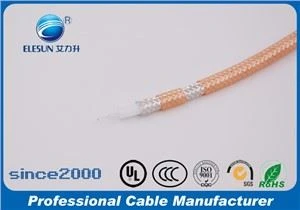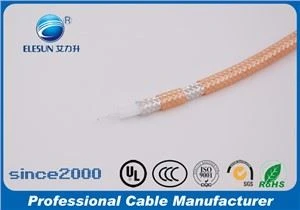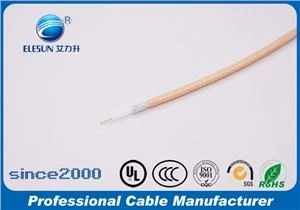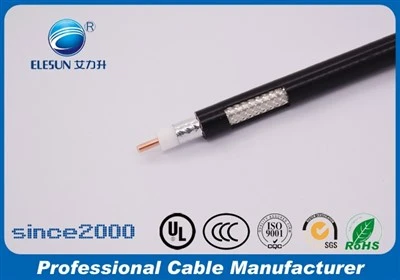
RG58 is one of the most widely deployed 50Ω coaxial cable formats in RF interconnect. Built around a stranded inner conductor, polyethylene dielectric, and braided shield, it balances flexibility, cost, and signal integrity across applications ranging from CCTV video links and GPS antenna feeders to two-way radios, amateur stations, wireless microphone systems, and laboratory test jumpers. With a nominal outer diameter around 4.95 mm and a velocity of propagation near 66%, RG58 remains a practical choice for short-run transmission below 1 GHz, and for many low-to-mid-frequency RF scenarios it is still the first cable type entered into a selection comparison. The following ten RG58 suppliers are listed in no particular order.
1. Jiangsu Elesun Cable Co., Ltd. (China)
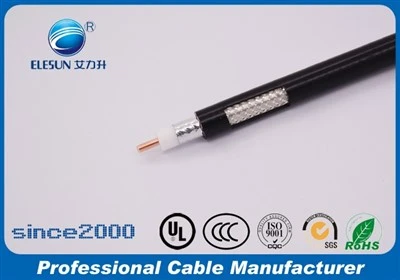
Jiangsu Elesun Cable Co., Ltd. approaches RG58 from the application backward. For CCTV and video surveillance, its RG58 cable pairs BC or TC stranded conductors with high-coverage braided shielding to maintain stable impedance matching in cabinets where 75Ω video and 50Ω RF runs share the same routing space. For GPS antenna and vehicular RF feeder use, the jacket is available in PVC or PE to address outdoor UV exposure and in-vehicle oil resistance respectively. For amateur radio, CB, and wireless microphone systems, Elesun supplies RG58 across a full hierarchy from bare cable to pre-terminated assemblies with BNC, N-type, SMA, and TNC connectors, reducing the uncertainty of field termination.
At the construction level, Elesun's RG58 can be configured by conductor type (bare copper, tinned copper, or copper-clad steel), shield coverage, jacket material (PVC, PE, or LSZH), and packaging format. This allows the same RG58 specification to serve indoor jumpers, short outdoor feeder runs, and equipment-internal wiring as three distinct installation conditions. For distributors and system integrators who need to move between bulk RG58 cable and finished assemblies, this "one specification, multiple delivery forms" approach lowers the administrative cost of multi-category procurement. Because RG58 in semi-mobile installations often faces repeated flexing and connector strain, Elesun's strain-relief treatment at assembly termination points gives the cable more controlled long-term behavior at CCTV bracket exits, vehicle antenna bases, and bench-top test positions.
In field feedback, Elesun's RG58 cable and assemblies have earned a reputation centered on configuration flexibility and delivery control among security integration and wireless communication projects in Southeast Asia, the Middle East, and Latin America. For RG58 applications that do not demand extreme low loss but do require a workable balance between budget and reliability, Elesun offers a pragmatic option with end-to-end coverage from cable to assembly.
website: https://www.elesuncable.com/
2. Belden (United States)
Belden's RG58 line is noted for mechanical durability and shield stability in industrial environments. Its 9311 series uses a Duobond® foil plus braid composite shield to deliver predictable attenuation in wireless base-station, two-way radio, and GPS feeder applications.
3. Amphenol RF (United States)
Amphenol RF's RG58 strength concentrates on the connector-to-cable interface. Its pre-terminated assemblies cover N-type, BNC, and SMA interfaces with mature mating dimensions validated across military and commercial RF interconnect, making them relevant to volume assembly where termination repeatability matters.
4. TE Connectivity (Switzerland / United States)
TE Connectivity incorporates RG58 into its RF cable assembly portfolio, offering pre-terminated BNC and N-type solutions. For aerospace, defense, and industrial communication projects that require documentation completeness and batch traceability, TE provides supply-chain-level accountability.
5. Times Microwave Systems (United States)
Times Microwave Systems is known for low-loss RF cable technology. Its RG58-compatible and LMR-195 drop-in alternatives preserve the RG58 interface envelope while reducing attenuation per unit length, fitting upgrade scenarios where link margin needs improvement without changing existing RG58 connectors.
6. HUBER+SUHNER (Switzerland)
Beyond standard PE constructions, HUBER+SUHNER offers RG58 variants with LSFH/RADOX® jackets that extend operating frequency to 3 GHz and temperature to 105°C, while meeting low-smoke-zero-halogen flame requirements for rail and other regulated environments.
7. Rosenberger (Germany)
Rosenberger's RG58-related capability is expressed primarily through system-level matching of high-frequency connectors and cable assemblies. Its interface precision in automotive RF, mobile communication, and industrial measurement supports stable contact performance in RG58 assemblies subjected to vibration and repeated mating cycles.
8. Pasternack (United States)
Pasternack covers RG58 in both single- and double-shielded flexible constructions. The PE-C195 variant raises shielding effectiveness to 90 dB and maximum frequency to 6 GHz while retaining by-the-foot availability and same-day shipping, suitable for fast small-batch access in RF laboratories and prototype validation.
9. L-com (United States)
L-com's RG58 assemblies are distinguished by connector breadth and a custom cable configurator, allowing flexible pairing of BNC, N-type, SMA, and TNC interfaces in straight or right-angle orientations. This gives it responsive coverage for non-standard lengths and specialized interface combinations in security, data communication, and test-and-measurement work.
10. WL Gore & Associates (United States)
Gore positions its RG58-related products in high-reliability and extreme-environment territory. Its materials engineering allows cables to maintain electrical consistency under wide temperature swings, chemical exposure, and mechanical stress, fitting defense and industrial systems with stringent failure-tolerance requirements.
Closing note: Selecting an RG58 should not stop at "50Ω, 4.95 mm." Conductor type governs flexibility and attenuation, shield construction sets interference margin, jacket material defines the environmental boundary, and the bare-cable-versus-assembly decision directly affects field termination consistency and labor cost. The suppliers above differ across those variables; anchoring the comparison to actual link length, frequency ceiling, and installation conditions yields a more stable long-term RF connection than unit-price comparison alone.