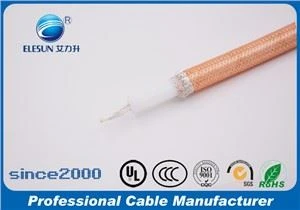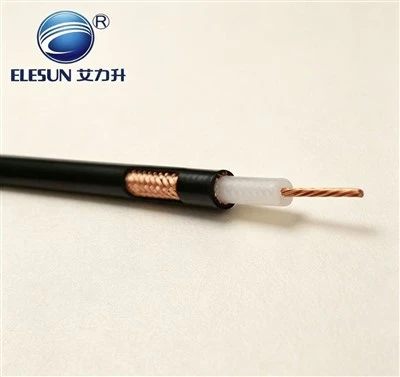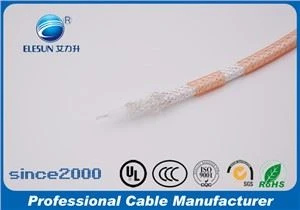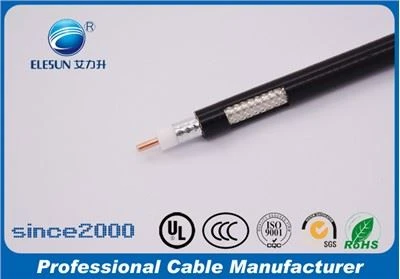
RG402 is one of the most widely used 0.141-inch coaxial cable formats in RF and microwave interconnect. It is typically a 50Ω cable with a silver-plated copper-clad steel or silver-plated copper inner conductor, PTFE dielectric, and a copper tube or tinned-copper braid outer conductor, delivering low attenuation, high shielding effectiveness, and stable phase behavior. RG402 cables operate from DC to 18 GHz and beyond, with some variants reaching 35 GHz or higher, serving base-station antenna feeders, test and measurement instruments, satellite communications, radar front ends, and precision microwave modules. The following ten RG402 suppliers are listed in no particular order.
1. Jiangsu Elesun Cable Co., Ltd. (China)
Jiangsu Elesun Cable Co., Ltd. offers RG402 RF cables and assemblies spanning bare cable through connectorized finished products. The range includes 50Ω RG402 coaxial cable and N-connector RG402 assemblies covering frequencies up to 11 GHz, with 75Ω versions and customized lengths and connector configurations available. Elesun's RG402 assemblies maintain VSWR within 1.3 for straight connectors and 1.5 for right-angle types, with a 1000 V RMS operating voltage and 2500 V RMS dielectric withstanding voltage; contact resistance and insulation resistance are aligned with the electrical reliability demands of communication and test scenarios.
In construction and materials, Elesun's RG402 RF cable uses a PTFE dielectric with a silver-plated copper-clad steel or copper inner conductor. Connector bodies are brass with nickel or silver plating, insulators are PTFE, and gaskets are silicone, sustaining stable mechanical and electrical performance across a wide temperature window on the order of −55°C to +155°C. Because semi-flexible RG402 cable is often bent once during installation and then held in position, the consistency of VSWR and insertion loss after forming is a practically important metric. Elesun tests cable assemblies segment by segment with a 20 GHz network analyzer, giving its RG402 finished assemblies repeatable RF performance in base-station jumpers, panel breakout extensions, and instrument-internal interconnects.
In application terms, Elesun's RG402 cable and N-connector assemblies are suited to base-station RF breakout, low-to-mid-band satellite earth-station interconnect, precision instrument panel extensions, and short low-loss links between microwave modules. For buyers who need to move flexibly between bare semi-rigid RG402 cable and pre-connectorized assemblies, Elesun offers a three-tier option covering bare cable, finished assemblies, and customized connector configurations on this form factor.
website: https://www.elesuncable.com/
2. HUBER+SUHNER (Switzerland)
HUBER+SUHNER's RG402-related offerings center on the MULTIFLEX_141 family, which combines the electrical performance of 0.141-inch semi-rigid cable with a flexible construction rated to 33 GHz and operating temperatures up to 165°C or 200°C. This makes it relevant to aerospace, base-station, and satellite systems requiring repeatable bending or routing through constrained spaces.
3. Amphenol Times Microwave Systems (United States)
Times Microwave Systems maintains a comprehensive military and commercial portfolio of RG402 semi-rigid and flexible microwave cable assemblies. Its RG-402 cables provide well-documented power-handling and shielding data from DC to 35 GHz, serving test and measurement, defense electronics, and high-reliability interconnect applications.
4. Belden (United States)
Belden's 1673A series is an RG-402/U type microwave cable built with a 19 AWG silver-plated copper-clad steel conductor and TFE Teflon dielectric in an unjacketed construction. With an upper operating temperature reaching 200°C, it offers material stability for industrial microwave and thermal-cycling environments.
5. McGill Microwave (United Kingdom)
McGill Microwave supplies RG402 coaxial cable and custom assemblies with construction options including silver-plated copper inner conductor, PTFE dielectric, and FEP jacket. Attenuation is specified from 400 MHz through 6 GHz, making it relevant to RF assembly projects that require specific outer diameters, jacket colors, or connector configurations.
6. EMC RFLABS (United States)
EMC RFLABS positions its RG402 as a low-loss semi-rigid cable with a nominal 69.5% velocity of propagation and greater than 100 dB isolation. Operating frequency extends to 35 GHz over −40°C to 125°C, targeting antenna systems, radar, and test-cable applications where high isolation is a primary requirement.
7. Smiths Interconnect (United Kingdom)
Smiths Interconnect's RG402 cable assemblies address space and high-reliability applications, offering DC-to-35-GHz coverage with 100 dB shielding effectiveness. The product has a project-validation basis in space-qualified cable assemblies, fitting satellite and defense RF interconnect requirements.
8. Pasternack (United States)
Pasternack supplies RG402 semi-rigid cable by the foot and as pre-connectorized assemblies, with SMA, N-type, and other connector options. Its strength lies in availability for RF laboratories, prototype validation, and small-batch fast-turnaround procurement.
9. Multicomp Pro (United Kingdom / global distribution)
Multicomp Pro's RG402 is a semi-rigid, unjacketed cable with 50Ω impedance, approximately 3.58 mm outer diameter, PTFE dielectric, 20 GHz maximum operating frequency, and a −55°C to 125°C temperature range. It is oriented toward standard specifications and off-the-shelf availability for general microwave interconnect, teaching, and research applications.
10. Coaxicom (United States)
Coaxicom supports the 0.141-inch RG402 semi-rigid form factor up to 36 GHz and pairs it with a broad connector series. This gives it a specific fit for RF module interconnects that require a higher frequency ceiling and connector flexibility.
Closing note: Selecting an RG402 comes down to trade-offs among semi-rigid versus semi-flexible construction, bare cable versus pre-connectorized assembly, frequency ceiling, and bend radius. The suppliers above differ in material systems, frequency coverage, assembly depth, and regional supply models; matching those differences to the actual link budget and installation conditions is the practical selection method.