

As a supplier of RG178U coaxial cables, I often encounter inquiries about the return loss of this product. Return loss is a critical parameter in the field of coaxial cables, which directly affects the performance and efficiency of the cable. In this blog, I will delve into what return loss is, how it relates to RG178U, and its significance in practical applications.
Understanding Return Loss
Return loss is a measure of how well a device or system matches the impedance of the transmission line. In the context of coaxial cables like RG178U, it quantifies the amount of signal that is reflected back towards the source instead of being transmitted through the cable. This reflection occurs when there is an impedance mismatch between the cable, connectors, and the connected devices.
Mathematically, return loss is expressed in decibels (dB) and is calculated using the formula:
[RL = - 20\log_{10}\left(\frac{V_{reflected}}{V_{incident}}\right)]

where (V_{reflected}) is the voltage of the reflected signal and (V_{incident}) is the voltage of the incident signal. A higher return loss value indicates a better impedance match and less signal reflection.
Return Loss of RG178U
RG178U is a type of coaxial cable known for its small size and high flexibility, making it suitable for a wide range of applications, including RF and microwave circuits. The return loss of RG178U depends on several factors, including the frequency of the signal, the quality of the cable construction, and the connectors used.
Typically, for RG178U, the return loss is specified over a certain frequency range. For example, at lower frequencies (e.g., up to 1 GHz), the return loss can be around 20 dB or better. As the frequency increases, the return loss may degrade due to factors such as skin effect and dielectric losses. At higher frequencies (e.g., 10 GHz), the return loss might be around 15 dB or so.
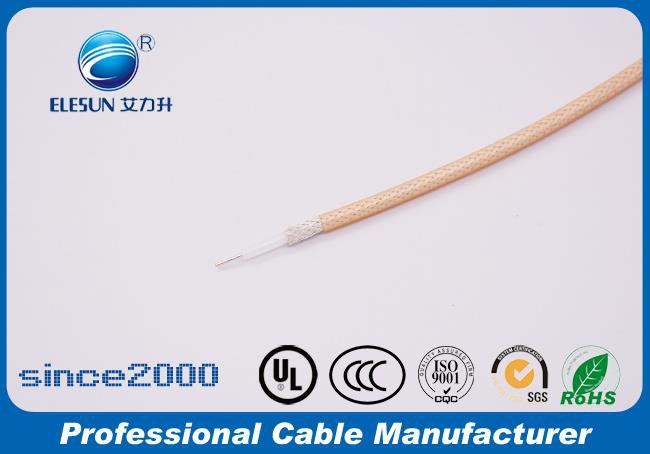
The cable's construction plays a crucial role in determining the return loss. RG178U usually has a solid copper center conductor, a dielectric material (such as PTFE), and a braided outer conductor. A well - constructed cable with uniform dielectric properties and proper shielding can help maintain a good impedance match and thus a high return loss.
Importance of Return Loss in RG178U Applications
- Signal Integrity: A high return loss ensures that most of the signal is transmitted through the cable without being reflected back. This is essential for maintaining the integrity of the signal, especially in high - frequency applications where even small signal reflections can cause interference and distortion.
- Power Efficiency: When there is a significant return loss, the reflected power is wasted. In applications where power efficiency is crucial, such as in wireless communication systems, a high return loss helps to minimize power losses and improve the overall efficiency of the system.
- System Performance: In complex RF and microwave systems, the return loss of individual components, including RG178U cables, can have a cumulative effect on the overall system performance. A low return loss in one cable can lead to signal degradation and reduced system performance.
Comparison with Other Coaxial Cables
It is interesting to compare the return loss of RG178U with other coaxial cables. For instance, the RG302 High Temperature Coaxial Cable and RG316 High Temperature Coaxial Cable are also popular choices in high - temperature and high - frequency applications.
RG302 generally has a similar return loss performance to RG178U at lower frequencies. However, due to its different construction and larger size, it may have better return loss characteristics at higher frequencies. RG316, on the other hand, is known for its excellent shielding properties, which can result in a relatively high return loss over a wide frequency range.
The RG178 High Temperature Coaxial Cable shares many similarities with RG178U in terms of return loss. Both are designed to provide good impedance matching and low signal reflection, but the specific return loss values may vary depending on the manufacturing process and the quality of the materials used.
Factors Affecting Return Loss of RG178U
- Connector Quality: The connectors used with RG178U can significantly affect the return loss. Poorly made connectors can introduce impedance mismatches, leading to increased signal reflection. It is important to use high - quality connectors that are properly installed to ensure a good impedance match.
- Cable Bending: Excessive bending of the RG178U cable can change the physical properties of the cable, such as the distance between the center conductor and the outer conductor. This can result in an impedance mismatch and a decrease in return loss.
- Environmental Conditions: Temperature, humidity, and other environmental factors can also affect the return loss of RG178U. For example, high temperatures can cause the dielectric material to expand, which may change the impedance of the cable and reduce the return loss.
Measuring Return Loss of RG178U
To measure the return loss of RG178U, specialized equipment such as a vector network analyzer (VNA) is typically used. The VNA sends a signal through the cable and measures the reflected signal. By comparing the incident and reflected signals, the return loss can be calculated.
It is important to note that the measurement should be carried out under controlled conditions to ensure accurate results. The cable should be properly terminated with the correct impedance load, and the measurement setup should be calibrated to eliminate any errors.
Conclusion
In conclusion, the return loss of RG178U is a crucial parameter that affects the performance and efficiency of the cable. A high return loss indicates a good impedance match and less signal reflection, which is essential for maintaining signal integrity, power efficiency, and overall system performance.
As a supplier of RG178U, we are committed to providing high - quality cables with excellent return loss characteristics. Our RG178U cables are manufactured using the latest technology and high - quality materials to ensure optimal performance.
If you are interested in purchasing RG178U coaxial cables or have any questions about return loss or other cable parameters, please feel free to contact us for further discussion and procurement negotiation. We look forward to working with you to meet your specific requirements.
References
- "Coaxial Cable Handbook" by Andrew Company
- "RF and Microwave Circuit Design for Wireless Applications" by Reinhold Ludwig and Pavel Bretchko


